Rethinking Digital Marketing: From Tactics to Integrated Strategy

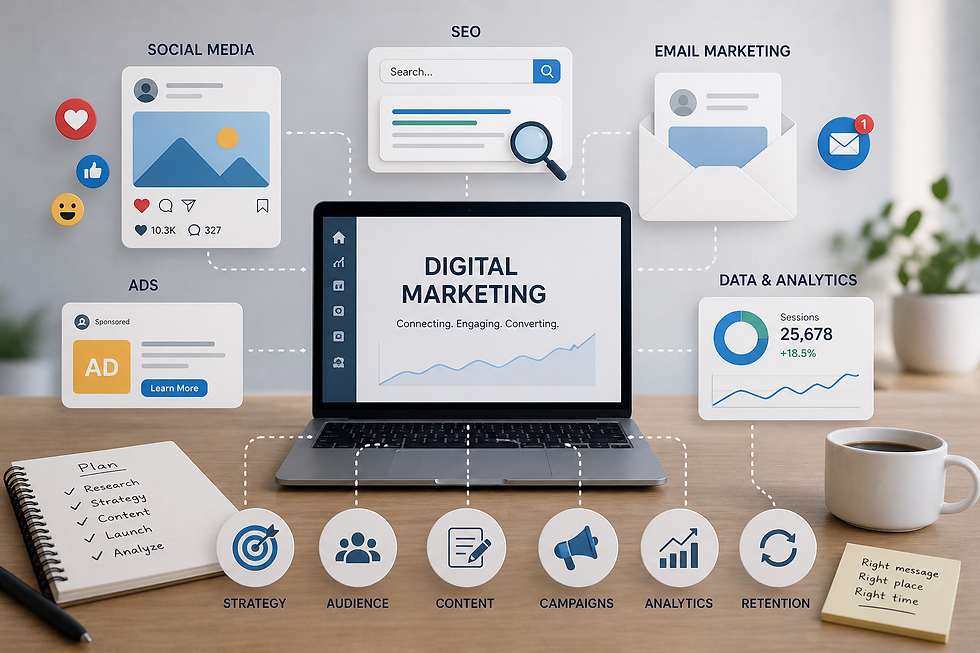
When I first wrote about digital marketing, I was excited about what I was going to learn. I saw it mainly as a set of tools—social media, ads, data, and platforms working together to promote products more efficiently. I understood that personalization and targeting were important, but at the time, my thinking was still quite surface-level. I focused more on what digital marketing does rather than how it creates real value for people.
During this semester, I also built a much stronger foundation in key digital marketing skills. I learned how SEO works and why it matters for visibility, especially in capturing people who are already searching for solutions. I gained a clearer understanding of email marketing. It is not just a communication tool, but a way to nurture relationships and guide customers throughout their journey. I also started to see how metrics like views, likes, and engagement on social media are not just numbers, but signals of how well content connects with an audience. Something really important is how to think about attracting new customers while also keeping existing ones, balancing acquisition with retention in a more strategic way.
Takeaway from the Final Project "Chewy"

Our group chose Chewy as the company for our campaign project, and it turned out to be a valuable experience. It gave me the opportunity to apply what I’ve learned and practice the full process of developing a campaign, from research and strategy to creative execution.
One of the biggest changes is how I now think about integration. Before, I viewed different channels (social media, email, search, etc.)as separate tactics. But in our campaign, everything was designed to work as one connected system. For example, we didn’t just run ads. We built a full journey: awareness through video and podcasts, engagement through social creators, and conversion through CRM and personalized emails. Effective digital marketing isn’t about isolated touchpoints. It’s about how those touchpoints connect and guide the consumer over time.

Another shift is how I understand the role of insight. Earlier, I thought digital marketing success came mostly from good execution. Now I see that it starts much earlier, with a strong understanding of the audience. In our project, we identified that younger pet owners feel overwhelmed because pet care is fragmented. That single insight shaped everything—from the “one system” idea to the messaging and channel strategy. Strategy is not just planning—it’s about solving a real tension in people’s lives.
My view on the role of content has also changed. Before, I thought content was mainly for engagement or visibility. But now I understand that content can build trust and authority. For example, using vet-backed information and educational content wasn’t just informative. It positioned Chewy as a reliable partner, not just a retailer. That’s a much deeper role than I originally considered.
AI's Role in Marketing

My view on AI has also evolved. At the beginning of the semester, I saw AI mostly as a tool to make marketing faster and easier. Now, I think the real question is how to use it responsibly. AI can help with data analysis, content generation, and optimization, but it shouldn’t replace human insight, creativity, or judgment. In our class, the most valuable ideas (such as the core concept and emotional positioning) came from human thinking, not from automation.
Conclusion
Overall, my understanding of digital marketing has become more strategic and more human-centered. It’s no longer just about platforms or performance metrics. It’s about building systems that simplify people’s lives, create meaningful connections, and deliver value consistently in every interaction.


Comments